
Disclosure: Links marked with an asterisk (*) are affiliate links. If you click through to make a booking or a purchase, I receive a small commission at no extra cost to you. As an Amazon Associate I earn from qualifying purchases.
The Ultimate Holiday Packing Checklist
for Autistic and ADHD Children
Packing for any family trip is an art form, but when you are managing neurodivergent conditions such as ADHD, autism, dyspraxia or sensory processing differences it requires a whole new level of strategy.
As parents we know that travel disruptions can heighten anxiety, and affect sensory capacity - this means spending time on careful prep work is even more essential.
The secret to successful neurodivergent family travel isn't about packing everything—it is about packing the exact tools, comforts, and safe items that keep your holiday regulated, predictable, and fun.
Whether you are prepping for a weekend road trip or getting ready to navigate a busy airport terminal, having a structured process and clear routine makes all the difference.
Here is our tried-and-tested approach to getting organized without losing your peace of mind.
Our Two-Stage Packing Strategy for Autism-Friendly Family Travel
With the boys' sensory and emotional needs constantly evolving, we have to think carefully in advance of every trip. It's a balance between not overpacking and taking what we need to help the boys stay calm and regulated in a new and unfamiliar environment.
Our structured autism friendly approach to packing combines two stages:
Stage 1: Your Essential Safety & Regulation Checklist
Create a list of essential items you know you have to pack to ensure you can travel safely (physically and emotionally) - this is in addition to travel documents.
Our Stage 1 list includes: essential medications, night time monitors, a power block, mobile phones, selection of safe foods and sensory comfort items such as ear defenders, a soft plushy toy and specific hygiene items.
Ask yourself this question; "If we lost all our belongings, and were left with only these 10 things, would we be ok?".
This can and does change so always double check this list carefully before each journey.
For more advice and top tips on travelling as an autistic family read our special article:
Exploring the World: A Beginners Guide to Travelling with Autistic Children
Stage 2: Comfort & Comfort-Zone Extras (Worth the Space!)
Create a second list for items that make life easier for your kids while they are away—which naturally makes life easier for you, too! These might not be standard holiday packing items, but we have learned they are absolutely worth the suitcase space.
Consider packing things like:
-
Familiar Tableware: Your child's preferred plates, bowls, tea trays, or cutlery to keep mealtimes predictable.
-
Safe Foods: Your kids' favourite dry foods and snacks to prevent holiday hunger strikes.
-
Bedding Protection: Dry night towelling mats (you can wash and dry them in a single day) - we use these Peapod mats via Amazon*. They have saved us from ruining a hotel / cottage mattress that didn't have a waterproof mattress protector supplied on multiple occasions. Although they are a little bulky they definitely earn their place in the suitcase! They boys also like them because they make a new bed familiar, it still smells and feels like home because we use them in both places.
-
Well-Stocked First Aid Bag: Plenty of Calpol, Nurofen, antiseptic wipes, plasters, Anbesol, and Savlon.
-
Visual Supports: Laminated visual schedules and personalized social stories - we use widgit.com to make ours.
-
Laundry Supplies: Non-biological liquid washing pods, as European supermarkets heavily stock biological formulas which can irritate sensitive skin.
💡 Travelling Light Tip: We pack as little clothing as possible. The boys prefer wearing their favourite outfits anyway, and I don't mind doing a bit of washing while we are away!
Short-Haul Flights: Our Autism Carry-On Luggage Checklist
Flying on budget airlines doesn't have to mean paying for expensive baggage upgrades. We rarely pay extra for large cabin bags on short-haul flights. Instead, my husband and I use standard under-seat backpacks that strictly fit the free cabin dimensions for airlines like easyJet or Ryanair.
By splitting these essential autism travel supplies between our two personal items, we ensure our children have immediate access to their comfort tools without overcrowding our space.
Free Under-seat Cabin Bag Checklists for Different Familiy Members
Parent 1: Mum's Backpack
1. First aid bag with daily /emergency medicines, GP letter and repeat prescription
2. Amazon Fire Tablet
3. Blue-tooth headphones
4. Portable battery pack with USB lead
5. Sunglasses
6. Simple notebook with 5 coloured pens
7. Twin packs of fruit yoyo's (for kids during take off / landing)
8. Lightweight sarong - it has endless uses
9. Water bottle
10. Magazine
11. Lip salve tube / tin
I also wear a slim line cross body bag with zip fastening that contains:
-
Purse
-
Emergency paper currency (enough for first 24 hours)
-
Passports
-
Boarding passes
-
Mobile phone
-
Travel sick pills
-
Travel sick wrist bands
Parent 2: Dad's Backpack
1. Lunch bag with lots of dry/pouch snacks for boys (plane delays and queues)
2. Amazon Fire Tablet
3. Blue-tooth headphones
4. Portable battery pack with USB lead
5. Sunglasses
6. Mobile Phone and Charger
7. Bag of Colin Caterpillars (take off / landing)
8. Thin jumper
9. Water bottle
10. Book
11. Two spare supermarket plastic bags
Child under seat Backpack
Each child has a backpack containing:
-
Bento meal box
-
Water bottle
-
Sunglasses: plane window shutters are up during takeoff / landing, the sunlight can be very bright
-
Noise-cancelling ear defenders
-
A travel pack of wet wipes.
-
Pencil case containing fidget toys
-
Puzzle / activity magazine (or book)
-
Small soft comfort toy (like a worry monster)
-
Full change of spare clothes or pyjamas, depending on space
-
Toothbrush
Hydration Strategy
-
Take empty reusable water bottles through security.
-
Most major airport terminals have hydration stations airside,
-
Filling up here is much cheaper than buying individual plastic bottles.
-
Alternatively you can buy large 1.5L water bottles and share the water out between your own reusable bottles.
🧳 Choosing the Right Airline Travel Bags for Sensory Success
The physical baggage you choose plays a massive role in how smoothly your travel experience runs. When you are managing airport transitions, holding hands, and monitoring sensory triggers, your luggage needs to work with you, not against you.
Hard Shell vs. Soft Case Suitcases
-
Hard Shell Suitcases: Ideal for checked baggage. The rigid exterior prevents your child's non-negotiable safe foods, sensory toys, and home kitchen items from being crushed. Models featuring integrated latches instead of traditional zippers provide faster, hassle-free access during sudden meltdowns.
-
Soft Fabric Cases: Best suited for under-seat cabin bags and carry-on use. They offer flexible exterior pockets to stow a Hidden Disabilities Sunflower lanyard or a communication board for instant access. They are also lighter, conserving energy when walking through vast terminals.
-
The Hire Car Flexibility Factor: We have found large soft fabric bags to be incredibly useful when renting a vehicle at the airport. You can easily pull out all of your internal packing cubes and stash them creatively around the car (in the footwell, under the seat, etc.). Once emptied, fold the fabric bag down entirely flat so it takes up minimal room. This has saved us on a number of occasions when the hire car we were given was not as big as we had been expecting!
One Large Suitcase vs. Multiple Smaller Pieces
-
The Case for Multiple Small Bags: Distributing your items across smaller, color-coded bags or backpacks makes it vastly easier to organize the room once you arrive. It gives children clear physical boundaries for their own belongings and keeps the living space visual clutter-free.
-
The Hidden Risk: Having your hands entirely occupied by multiple pulling handles or slipping shoulder straps makes it very difficult to guide an anxious child through a busy crowd.
Our Luggage Recommendation:
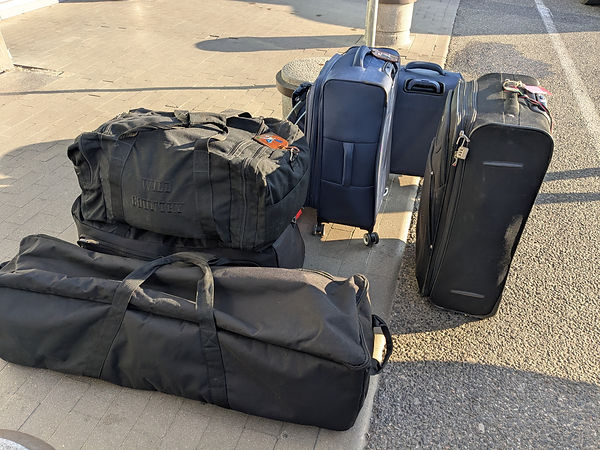
If you intend on using airport transfers, taxis or continuing your journey on public transport consolidate your heavy gear into one (or two) large, high-capacity checked bags on 4-wheel spinner wheels. This will enable you to push it effortlessly with one hand, keeping your other hand completely free for your child.
Supplement this with lightweight backpacks or small wheelies designed for the free under-seat allocation.
If you are hiring a car consider including at least one large soft bag, just in case!
The Ultimate Car Hire Hack: Trunki BoostApak Backpacks
When the boys were smaller and we were hiring a car at our destination, we would swap their standard daypacks for the Trunki BoostApak. These were an absolute game-changer for our neurodivergent family travel and saved us loads of money in Norway, Italy and Latvia!
-
What they are: A hollow, hard-shelled car booster seat featuring integrated backpack straps.
-
Storage capacity: The zippered under-seat compartment has enough space to hold a bento lunchbox, a magazine, toys, and ear defenders.
-
Airline rules: They perfectly match standard free hand luggage dimensions on budget flights.
-
The savings: You can transition the kids straight from the plane into your hire car with these certified booster seats. In many European countries car seats are compulsory, so this simple swap has saved us up to £120 per week in extra rental car fees!
🎒 Our Tried-and-Tested Recommendation:
We used our Trunki Booster Seats for years until the boys got too big and they were truly brilliant and totally worth the initial investment. You can find the our exact genuine, R129 safety-certified Trunki BoostApak Travel Booster Seat Backpack via Amazon*.
Our Top 10 Packing Essentials for Neurodivergent Families (And Why It’s Okay to Overpack)
01
Hidden Disability Cards and Lanyards
Consider wearing or displaying a sunflower lanyard, especially in transport hubs. Although airports can be overwhelming you don't have to manage alone.
The Hidden Disabilities Lanyard is a gentle, quiet way to let airport / train / bus staff know that your family might need a little extra time, clearer communication, or a bit of patience.
Disability Documentation: Slip any disability ID cards, National Access Cards, or doctor's letters into your handbag, this includes one that are issued by local authorities, rather than external bodies. We have used them abroad with mixed success so always worth including.
For more information on how to get your own Hidden Disability Lanyard read our dedicated post.
02
Invest in Coloured Packing Cubes
Mess and clutter can quickly lead to sensory overload, especially when you are living out of a suitcase on holiday. Packing cubes are our secret weapon for stress free travel. I started using them way back in 2014 on a 5 week backpacking trip around Sth East Asia. Now I couldn't imagine going away without them, even on a one night minibreak!
Packing cubes help neurodivergent parents and kids know which clothes go where and help keep sleeping spaces super tidy. When everything has an obvious colour coded home, everyone (especially kids) know where to find their special items, and where to put them away.
Packing cubes also makes it super quick to divvy up the clothes into the right rooms when you get to your accommodation - perfect if its late in the day or the kids are begging for food.
How to make packing cubes work for your family:
-
Assign Colours: Give each family member or category their own colour (e.g., Dad gets blue, Mum gets yellow, kitchen items go in green). This visual identity makes it instantly clear whose items are whose without anyone having to dig through bags.
🎒 Our Tried-and-Tested Recommendation:
We use the heavy-duty Savisto Multi-Coloured Packing Cubes via Amazon* for this exact reason. The vibrant, distinct colours make it incredibly easy to assign a visual identity to each family member, and the mesh windows let kids peek inside without unzipping everything.
-
Offer Controlled Autonomy: Allow each child one or two packing cubes for theirs personal "extras." Let them fill these cubes with whatever toys or comfort objects they choose. If their items fit in their packing cube(s), it comes on holiday. This simple, tangible rule reduces pre-trip arguments and gives your kids a safe sense of control over their own packing process.
03
Feel Confident Prioritising Sensory Comforts
Supporting your own and your child's emotional needs when travelling is just as vital as meeting their practical ones. New environments, loud noises, and altered routines can quickly trigger sensory overload or anxiety. Making space for key sensory items can help kids cope when they feel anxious or overwhelmed. How to make it work:
-
Protect the "must-takes": Free up suitcase space for your child's core regulation tools. Whether it is a worry monster, chewies, or a favourite soft blanket, these items can be considered essential medical gear for your trip.
-
Pack portable regulation: Keep small tactile items like fidget toys or a fresh tub of playdoh easily accessible, particularly during travel days when queues and 'waiting' is likely.
-
Don't worry about size: Never feel guilty about packing items that look "bulky" or unconventional to others. If it helps your child feel safe and regulated, it deserves a spot in the bag, and yes the additional baggage fees.
04
Use Visual Packing Checklists
Travel involves a lot of abstract concepts that can trigger pre-trip anxiety. Giving your child a visual list of items to look for helps turn the packing process into a fun activity and supports them to better understand what is going to happen.
Enabling children to take charge of their own packing is particularly useful for demand avoidant kids like my eldest.
It also helps all children build their independence and transforms transition anxiety into positive anticipation.
-
Use simple pictures: Create a simple checklist featuring pictures of items next to the required quantity (e.g., a photo of a t-shirt with "x4" next to it).
-
Enable and value independence: Consider letting your child use the pictures to find and choose their own outfits. This gives them a safe sense of control over their holiday wardrobe. You can always go back afterwards and add in anything important they may have left out.
-
Encourage your kids to contribute: Always leave a few blank spaces at the bottom of the list. This allows them to add their own must-have items, respecting their feelings of control and autonomy.
05
It is Worth the Space to Pack Familiar Bedtime Items
Sleeping in an unfamiliar room with different sights, sounds, and smells can be deeply unsettling for an autistic child.
Packing some familiar elements from their bedtime routine signals to their nervous system that they are safe, making it much easier for them to relax and drift off to sleep.
-
Scents from home: Pack one or two of your child’s unwashed pillowcases from their bed. The familiar smell of home laundry provides instant comfort in a strange hotel room.
-
Protect the sleep routine: Don't hesitate to make room for their favorite soft toys, a special blanket, or a few beloved bedtime books. These are non-negotiable comfort items.
-
Add a safety light: Keep a small torch or a plug-in nightlight nearby. If they wake up disoriented in the middle of the night, being able to turn on a light helps prevent panic.
06
Prepare an Emergency Hand Luggage Cube
Luggage getting lost can and does happen. For an autistic child, losing familiar items (even temporarily) can cause an immediate crisis.
Having a dedicated "worst-case scenario" kit in your carry-on ensures that even if your checked bags are delayed or dont turn up you can still meet some important elements of your child's sensory and emotional needs.
-
Give the emergency cubes their own colour: Use one specific packing cube in your hand luggage to hold each child's favourite outfit, their toothbrush, and if you have space, a set of pyjamas and soft toy.
-
Secure the primary comforts: Always keep their absolute favourite comfort item and at least two dependable sensory toys with you in the cabin — never risk checking these in.
-
Keep sensory items accessible: Place this specific cube right at the top of your hand luggage so you can grab it instantly without having to rummage through bags mid-flight or in a long queue.
07
Bring Small Home Comforts
The transition to a new environment also brings with it a complete sensory shift; different water pressure, unfamiliar textures, and strange scents. Bringing small, everyday items from home acts as a sensory bridge, reducing environmental anxiety and making daily hygiene routines feel predictable and safe.
-
Pack everyday textures: If your child is highly sensitive to touch, pack their own familiar flannel, bath towel, or a favourite bath toy from home.
-
Stick to known scents: Bring your usual shampoo, body wash, and hand soap in travel bottles. The familiar scent instantly makes an unfamiliar bathroom feel a bit more like home.
-
Respect an item's utility: It might feel silly to pack a towel or a bath toy, but if it removes the anxiety of bath time on holiday, it is worth every single inch of suitcase space.
08
Its OK to Pack Your Own Kitchen Items
Unfamiliar textures, heavier weights, or different shapes of unfamiliar cutlery can cause sensory distress and potentially lead to mealtime refusal. While a child can physically eat off a different plate, the emotional cost of masking that discomfort is exhausting.
Adopt a bigger picture approach. Bringing your own kitchen items helps reduce anxiety and removes a sensory banner. For us it has meant the difference between eating 'some' of his safe foods and eating nothing on holiday.
-
Validate the need: Remind yourself that bringing home items is a tool for emotional safety. It directly reduces anxiety and keeps mealtimes calm and predictable.
-
Pack the favourites: Slip their favourite plate, bowl, cup, or specific cutlery set right into your bag.
-
Support safe eating: Keeping the sensory experience of eating identical to home makes it significantly more likely your child will continue eating their safe foods while away.
09
Take Safe Foods and Snacks
Many autistic children are "super-tasters" who notice even the slightest variation in ingredient brands, oil types, or seasoning blends. If a food doesn't taste exactly "right," it can feel unsafe to eat. Packing your own supply ensures your child stays nourished, hydrated, and regulated without the stress of food hunt panic.
-
Over-pack the essentials: Bring a generous supply of their absolute non-negotiable safe foods, snacks, and specific drinks or powders, especially when travelling abroad.
-
Remove the expectation to try new things: A holiday is already a massive sensory transition. Let mealtime be a safe zone of pure comfort and total predictability.
-
Protect the supply: Pack these snacks in sturdy, hard-shelled containers inside your luggage so they don't get crushed or broken during transit.
10
Pack What You Need to Make Transitions Easier
Holidays often mean unpredictable schedules, sudden changes, and new routines.
The visual supports and scaffolding you use at home to manage transitions are needed even more when you are away. They give your child a concrete roadmap of the day, turning an unpredictable environment into an understandable one.
-
Bring your home supports: Pack whatever visual aids work best in your daily routine, whether that is laminated schedules, picture cards, or timers.
-
Use a portable whiteboard: A small, lightweight magnetic whiteboard or clipboard with dry-wipe markers is perfect for sketching out or updating the day’s changing schedule on the go. We sometimes take it with us on more demanding day trips.
-
Pre-plan holiday specific visuals: Take a little time before the trip to create new, simplified visual schedules specifically tailored to the travel days and holiday excursions. I often create new ones just for the holiday - it really helps.
Planning Your Next Calm Adventure
Packing your bags is just the first step to a successful getaway. To help you navigate the actual travel days and plan stress-free itineraries, explore our dedicated, parent-tested by us guides for neurodivergent travel:
-
Navigating the Airport: Streamline your time at the terminal with our comprehensive guides on setting up Airport Special Assistance and understanding Airline Special Assistance features before you arrive at the boarding gate.
-
Taking the Train: If you are bypassing the skies and heading to Europe, read our honest review of using the London Eurostar Special Assistance desk at St Pancras, alongside our companion guide for navigating the return journey via Paris Eurostar Special Assistance seamlessly.
-
Exploring Cities: Once you are packed and ready to explore, check out our favourite Top London Attractions for Autistic Kids for low-demand, sensory-friendly itinerary ideas.
-
If you are crossing the channel, read our handpicked list of Activities for Autistic Children in Paris or follow our relaxed 5-Night Paris Family Itinerary to keep the whole trip calm and manageable.
Final Words of Encouragement Before You Close Your Suitcase
Ultimately, holiday packing for an autistic child is not about fitting everything into a perfectly minimalist suitcase—it is about packing enough familiar items to ensure their emotional safety and protect their routine.
If your bags are heavy with home comforts, safe foods, and extra sensory tools, let go of any travel guilt.
You are packing regulation, peace of mind, and joy for your family, and that is exactly what a wonderful parent does.
Trust your instincts, embrace your own way of traveling, and have a beautiful, calm journey!
Happy Travels x