
Visiting the London Eye with Autistic Children: A Sensory Guide & Top Tips
Is the London Eye Autism-Friendly? Our Real-World Parent Review
The London Eye has rightfully become a classic part of the London experience, popular with tourists and locals all year round. The boys had been asking to go on the "big wheel" for years, so they were thrilled to finally have the chance to ride inside one of the famous glass pods.
We first braved the attraction with our autistic kids on a cloudy day in February, and we loved it so much that we returned for a second trip in December.

Our winter visit was even better! It was beautifully festive, complete with holiday decorations and Christmas music playing; it was a magical start to a festive family day out on the Southbank and signalled the start of our Christmas celebrations!.
We weren't entirely sure how easy it would be taking our autistic children on the London Eye, but in the end, it was a straightforward experience. Read on for our full parent-tested sensory blueprint and top tips for a memorable trip.
Avoiding the Crowds + Skip the Queue
Peak-time Crowds
Having regularly walked along the Southbank during the peak spring and summer seasons, I've seen first-hand how seriously long the London Eye queue lines can become.
I would caution against taking your autistic child on the London Eye in the middle of a hot August afternoon. However if your only option is to visit during the peak seasons, then follow these key steps:
Aim for the very first slot in the morning or early evening.
Wear a sunflower lanyard and show your Access Card, National Disability Card or other documentation to staff at the Fast Track / Priority entrance and politely request to join the special assistance queue.
Pack every sensory tool you can think of in a backpack! If you forget ear defenders they can be hired on the day for £5 refundable deposit (price correct in 2026).
🎄Visiting the London Eye at Christmas & New Year
If you are tempted to visit London and experience the magic of the Christmas then a trip of the London Eye is a realistic and fun option. Make sure to follow the tips listed above, and treat it like you might a busy day in August, then you will be fine.
We went on the London Eye on the first Sunday in December; the added magic of the Christmas decorations and festive music completely transformed the atmosphere. We wore our Santa hats and afterwards enjoyed the lights along the Southbank. It was brilliant.
(Try and avoid the temptation to walk up Carnaby St, Regents St or any of the streets in between. We foolishly attempted it two years ago and I'm not sure who was more overwhelmed by the sheer volume of people, us or the boys).
Note: London Eye is shut for maintenance for 2 weeks each January. Check website for exact dates and seasonal opening times.

"Look, Mum!" In this photo from our festive trip on the London Eye, my youngest son’s hand is right over my mouth. He wasn't trying to hide my smile—he was trying to physically twist my head around because he was so captivated by the view over London and wanted me to look at it with him! Real-world travel with neurodivergent kids isn't about posing nicely for the camera; it’s about these intense, beautiful moments of shared wonder.
Off-peak Crowds
Our February trip was on a quiet Saturday afternoon, so while priority boarding was a helpful tool, the standard lines wouldn't have been disastrous.
How to Access the Priority Queue Line
You don't need to spend extra money on fast-track tickets.
The London Eye staff were incredibly friendly on both of our visits and there were absolutely no quibbles when we asked to join the priority line for speedy boarding.
We simply showed them our disability ID cards and were ushered right through.
Accepted Proof of Disability
While London Eye staff recognise and respond to the sunflower lanyard, to access the priority queue you need to show one of the following forms of documentation:
Nimbus Access Card
UK Disabled ID Card (DID Card)
A National Disability Card
A Disability Living Allowance (DLA) award letter or allowance book (for children under 16)
A valid Blue Badge
Any internationally recognized equivalent documentation
The Hidden Disability Sunflower Lanyard
London Eye staff instantly recognised our Hidden Disability Sunflower Lanyard and respond supportively. Read our article - Guide to getting a free sunflower lanyard for travel for more details.
The London Eye Security Experience
We were pretty impressed by the London Eye security team. They were very efficient with the bag searches, which reduced the wait at the barriers and responded well when one of the boys started get jumpy in the queue.
At the end of the flight visitors are funnelled down two long ramps back to street level, where there is a security guard to help manage crowds.
Safety tip if your child is prone to 'bolting'
After the excitement of the ride, this final slow moving line of people became a too much for our youngest.
The shoes came off and he bolted, squeezing his little body past the other people in the queue faster than I could catch him.
In desperation I shouted loudly to the guard on the exit "Stop that child" - imagine my relief when he did exactly that! Those precious extra seconds gave me the time I needed to catch up with our son and take him safely to a quiet space to calm down.
The On-board Experience
Neurodivergent Friendly Ride Time
The London Eye ride itself lasts for approximately 30 minutes offering a short and sharp experience that kept even our restless kids engaged.
Added to the pre-board and disembark wait times, the whole experience lasts around 60 minutes - even our youngest who gets extremely dysregulated in crowds was just about ok.
Personal Space Inside the Pods
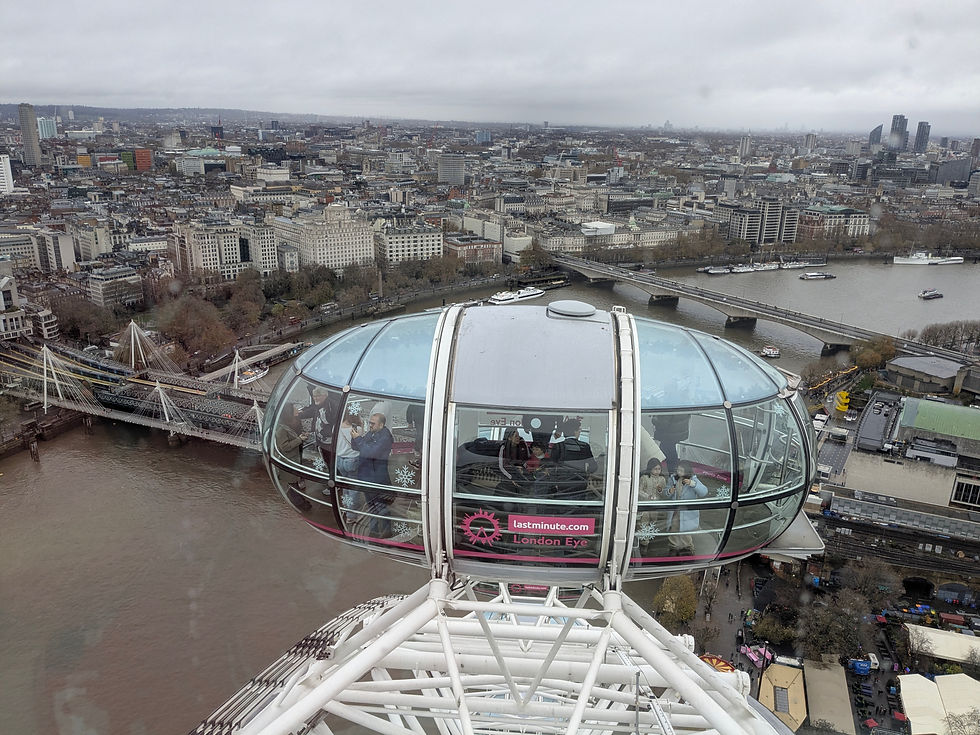
While the queue lines are tightly packed, once you walk into the pods the space opens up. They are more spacious then they look, and helpfully feature a large central bench in the middle.
On our visit there were about 14 other people in the pod (so 18 total), which did not feel at all overfilled - we still had enough personal space for the boys to feel relaxed environment even among strangers.
Official capacity of the pods is 25, but I didn't see any that were that full. There is a good chance there may be other families sharing with you (and sticking together), which actually creates more space than 20 random strangers all standing apart.
Managing Sensory Excitement & Loud Vocal Stims in the Pod
Like many parents of autistic children, we are acutely aware of how loud our boys can be, particularly in enclosed environments. We were very nervous about taking them into a small glass pod for 30 minutes with no escape if they began expressing themselves loudly or experienced sensory overload.
Predictably, the thrill of the ride meant we did end up being the loudest family in our pod!
Fortunately, the onboard audio guides use personal headsets that feed a commentary directly into the listener's ears. Many of the other passengers were wearing these and were not overly bothered by the boys' noisy expressions of excitement.
Expect Some Adrenalin!
During our first trip, the boys thoroughly enjoyed the initial part of the flight as the pod began to rise. They were excitedly pointing out landmark buildings they recognized and asking questions about Waterloo rail station and the red buses below.
However, as we neared the very top, the sheer height caught them off guard. They both got a little scared and found it difficult to relax. Because neither child typically has a fear of heights, it was a sudden sensory shift for them—and a reminder that anxiety can pop up unexpectedly when routines change.
What helped us in the moment was redirection.
We had them turn inward toward the centre of the pod and focus on our mobile screens for a few minutes. This helped distract them and blocked out the overwhelming horizon until the descent began. Thankfully, their feelings passed; they completely relaxed once the pod cleared the peak and perked right up for the journey down the other side.
The Benefits of a Repeat Visit on Emotional Regulation
On our second trip in December, the boys were able to call on their previous visit and we talked all about what we did last time before setting off.
Having this solid mental map definitely helped us all; they were significantly more confident, stayed regulated, and everyone was able to thoroughly enjoy the entire 30-minute experience from ground to peak.
Accessibility and Sensory Facilities
Because this attraction caters to a broad tourist demographic, the standard accessibility info on-site is fairly general. However, the official website features a fantastic sensory breakdown and a highly detailed visual story that maps out the entire day from start to finish.
Is the pod layout neurodivergent friendly?
The glass pods are structurally very simple, featuring a single large wooden bench in the centre that seats 4 to 6 people. Because most tourists spend the flight standing at the glass windows, the bench remains mostly empty.
This was a lifesaver when one of our boys needed to feel physically grounded and chose to lie flat across the bench to self-regulate.
Temperature Control: The pods are fully heated. In fact, we found it a bit too stuffy during our winter festive visit and quickly had to strip off our heavy winter coats, so consider dressing your kids in easily removable layers.
Emergency Support: There is a highly visible staff communication button inside the pod if your child experiences a medical or sensory emergency mid-flight.
Disabled Restrooms
Accessible toilets are available at ground level inside the main ticket hall. They were clean and well-maintained on both of our dates.
Booking London Eye Tickets & Disabled Concessions
Like most major London attractions, the London Eye gets extremely busy at weekends and during school holidays. If you want to avoid standing in long ticket queues (especially in the morning), it pays to plan ahead.
While single, concession and family day tickets can be purchased on the day they are definitely cheaper if you book them advance. The London Eye operates a dynamic pricing system, so the further in advance you book, the cheaper your tickets will be - peak times start from £33.
Free Essential Carer Tickets: Free carer tickets are only available from the official London Eye website. See above section for required evidence. A qualifying full price ticket (adult or child) must be ordered at the same time.
Standard Tickets (Flexible): The London Eye allows tickets to be re-scheduled up to an hour before your timed slot, but they cannot be refunded.
Standard Tickets (Refundable): If you want to buy refundable tickets, you need to book via a third party website - we recommend GetYourGuide; they offer a money back guarantee up to 24 hours before your booked time.
If you plan to visit more than one of the 'Merlin' attractions, then there are savings to be had by booking a multiple attraction pass.
For example it is entirely doable to structure your day like this:
Visit the SEALife Aquarium (Merlin) in the morning: aim for a 10am slot, or book their monthly autism friendly Quiet at the Aquarium at 9am
Follow this up with mid-morning trip on the London Eye
Visit the Jubilee Playground a short walk from the London Eye to decompress
Head home (or somewhere quiet) for lunch
This is precisely what we did on our festive December trip to London and it worked very well.
Merlin 12 month Pass: Entrance is free for annual Merlin Pass holders, however you still need to book you time slot at least 7 days in advance. For more information on this annual pass you can visit the Merlin Annual Pass Page*.
Parent Blueprint for a Successful London Eye Visit with Autistic Kids
The London Eye offers a truly unique perspective on the capital's geography. While being "stuck" in a pod with strangers might sound intense, the panoramic views offer an excellent visual distraction and ensure that everyone's focus is firmly focused outwards.
If you are planning a trip, here are our 5 core strategies for a successful flight:
Utilise the Visual Story: Download and print the official London Eye visual narrative a few days before your trip to take away the anxiety of the unknown.
Time your visit carefully: avoid the mid-day rush. Book early morning or late afternoon, and aim for the quieter shoulder months (like February) or look out for the magical festive setups in December.
Go all in on your sensory prepping: Pack a reliable pair of children's ear defenders, plenty of snacks, soft textures and your child's favourite fidget or oral stim tool. Consider sunglasses - on cloudy days or after rain the sun can break through and bounce brightly off the water and other wet surfaces.
Speak to the queue attendants: Remember to wear the sunflower lanyard and don't be afraid to advocate politely for your child. Show your National Disability Card or Access Card at the gate.
Be honest: If your child is vocally loud or has vigorous physical stims, gently explain this to the boarding staff. You can request to be placed in a pod with a reduced passenger capacity, and if the attraction isn't at peak capacity, they will do what they can to accommodate you.
Follow the flight with a planned decompression walk: The London Eye is situated right on the Southbank footpath. This pedestrianised walkway traces the edge of the river Thames all the way to Tower Bridge and serves up a sensory feast of street musicians, food carts, and plenty of crowds.
Or you can head straight to one of its many open spaces, there is a grassed area a short stroll away and the previously mentioned Jubilee Playground is great for letting kids burn off excess energy and any residual adrenaline.
If the weather is against you pop in to the nearby Southbank Centre - a cultural public space with cafes, lounges, art installations and plenty of toilets. Read our Top 10 London Attractions post for more information on this wonderful venue.
Mastering Your Autism-Friendly London Trip
Tackling major city landmarks like the London Eye requires a solid strategy, a slow pace, and the right tools. Keep planning your low-stress capital adventure with our practical parent-tested blueprints:
Plan the Rest of Your Day: Discover more sensory-friendly ideas in our countdown of the Top 10 London Attractions for Autistic Kids.
Survive a Multi-Stop Day: If you are trying to fit the London Eye into a busier schedule, read our step-by-step framework: 24 Hours in London with Kids: How to Avoid a Meltdown and Still Have Fun.
Navigating London Transport with Autistic Kids
Getting around a busy city can feel incredibly daunting at first. The dark, echoey, and crowded London Underground network involves steep escalators, intense heat, and sudden rushes of people that can trigger sensory overload in seconds.
To keep the boys regulated, we actively avoid the tube wherever possible. Instead, we design our itineraries so we can walk between Southbank attractions or use much calmer, fresher alternatives like river boats or buses.
The Eye's position on London's Southbank offers a number of journey options:
Walking from South of the river:
The nearest rail station (mainline and underground) on the south of the river is London Waterloo - the northern, jubilee, bakerloo, waterloo and city. The nearby Waterloo East Station is also an option, and can be reached via overground services from Charing Cross and London Bridge.
Waterloo itself also a large hub for London's red buses, with upwards of over 30 different passing through or very nearby - so it is worth considering taking the bus over the tube.
Walking from the North side of the river
You can approach the London Eye from Charing Cross (over the Hungerford pedestrian footbridge (a fun experience in itself) or from Westminster (which offers the chance to see Big Ben and the Houses of Parliament before crossing Westminster bridge.
Make the journey part of the fun
If you are visiting London for the weekend, we highly recommend booking an open-top hop-on, hop-off bus tour. It serves as a brilliant sensory circuit-breaker—giving the kids fresh air, fantastic up-close views of landmarks, and a predictable, seated safe bubble away from walking crowds. They also have a dedicated South Bank / London Eye stop.
To save hassle and stress on the day, you can pre-book fully refundable Hop-On, Hop-Off Bus Tickets in advance via GetYourGuide*.
Final Thoughts: Is the London Eye A Good Choice for Autistic Families?
Yes, absolutely. While the scale, crowd potential, and unexpected mid-air anxiety spikes mean it isn't a completely stress-free ride, the London Eye is a deeply rewarding experience when approached with a clear sensory strategy.
By managing the queues through special assistance, pacing your day along the Southbank, and keeping a visual redirection tool ready for the peak height, you can make beautiful, lifelong travel memories together.
Real-world neurodivergent travel isn't about everything going perfectly—it is about having the right tools to navigate the tricky moments with confidence.
Over to You - What's in Your London Travel Toolkit?
Have you braved the London Eye with your children yet, or are you planning a trip for the upcoming holidays?
We would love to hear what worked for you! Leave a comment below to share your own parent tips with our community.
Free Kids Travel Download
If you are planning a family rail adventure, don't forget to subscribe to our newsletter The Sunflower Suitcase and receive your Free Print-at-Home 18 page Kids Train Travel Passport and Sensory Guide. You can sign up here


Comments