
Stonehenge with Autistic Children: Magic, History, and Wide-Open Spaces
Updated: Aug 3
Stonehenge is a prehistoric megalith structure famous around the world. Beloved by tourists, this spiritual site is one of the most popular in England.
Is Stonehenge Good For Autistic Children?
Yes, Stonehenge is an excellent destination for neurodivergent families and despite the August tourists our autistic children loved their visit.
While it is a world-famous attraction that draws large crowds, the vastness of the landscape means you can easily find quiet pockets of open space to relax.
If you are planning a visit, here are the key travel facts to keep in mind:
Location: Situated on Salisbury Plain in Wiltshire, England (around 80 miles from London, making it doable as a long day trip).
The Journey: We visited Stonehenge on our way home from a family holiday on the Dorset coast. It was a gorgeous English summer day at the end of August with perfect blue skies. (If you are planning to extend your trip or base yourself in the wider region, make sure to check out our Visiting Bath with Autistic Kids: A Neurodivergent Travel Guide for an excellent nearby city itinerary!)
I was so excited to share the Stonehenge experience with them, I had been looking forward to it all holiday!
Managing the Crowds: Although it was the boys' first visit to Stonehenge, I had visited twice before. Knowing what to expect allowed me to put a clear plan in place. For our exact strategies on timing your day trips and handling busy tourist attractions, explore our Master Guide to Planning Calm Autism and ADHD Family Travel so you can all enjoy the experience to the absolute max.
Step Back in Time on Salisbury Plain
Owned and run by English Heritage, these giant stones are actually older than the pyramids! The stones and the surrounding historic landscape—including Avebury, Silbury Hill, and West Kennet Long Barrow—were designated a UNESCO World Heritage Site in 1986.
There is much more to do here than you would think. Read on to discover exactly how we spent our day and the activities our autistic kids liked the best!

Best Things to Do at Stonehenge for a Sensory-Friendly Day Out
Approaching Stonehenge on Foot: The Woodland Walking Route
The stone circle itself is around a mile from the car park. If you are short on time or mobility is an issue, then you can travel to the stones on the courtesy buses provided by English Heritage.
Alternatively, you can do what we did and walk there through the fields and a small woodland that run alongside the road.
It is an easy, non-strenuous walk that takes you across the plain and through a small section of wooded land.
The one-mile walk is easy to follow and offers plenty of space for kids to move freely.
There are longer, more adventurous routes, but the main path is well signposted and popular with other visitors. It was reassuring to see other people nearby, while still having enough room to relax and engage with the landscape.
Walking between the visitor centre and the stones is highly recommended. Walking the same ancient landscape as the original builders from 4000 years ago offers an elemental and moving experience. You truly feel as though you are stepping back in time.

Sensory Reset: Relaxing at Stonehenge with a Picnic
We timed our arrival at the circle perfectly for lunchtime. Feeling tired from the day's early start and the long walk across the fields, the boys were more than ready to spread out the rug and settle down for a chilled out picnic on the grass.
In an act of wonderful generosity, English Heritage allows visitors to spend as much time around the stones as they like. To encourage this there are a number of benches available for people linger and enjoy the atmosphere.
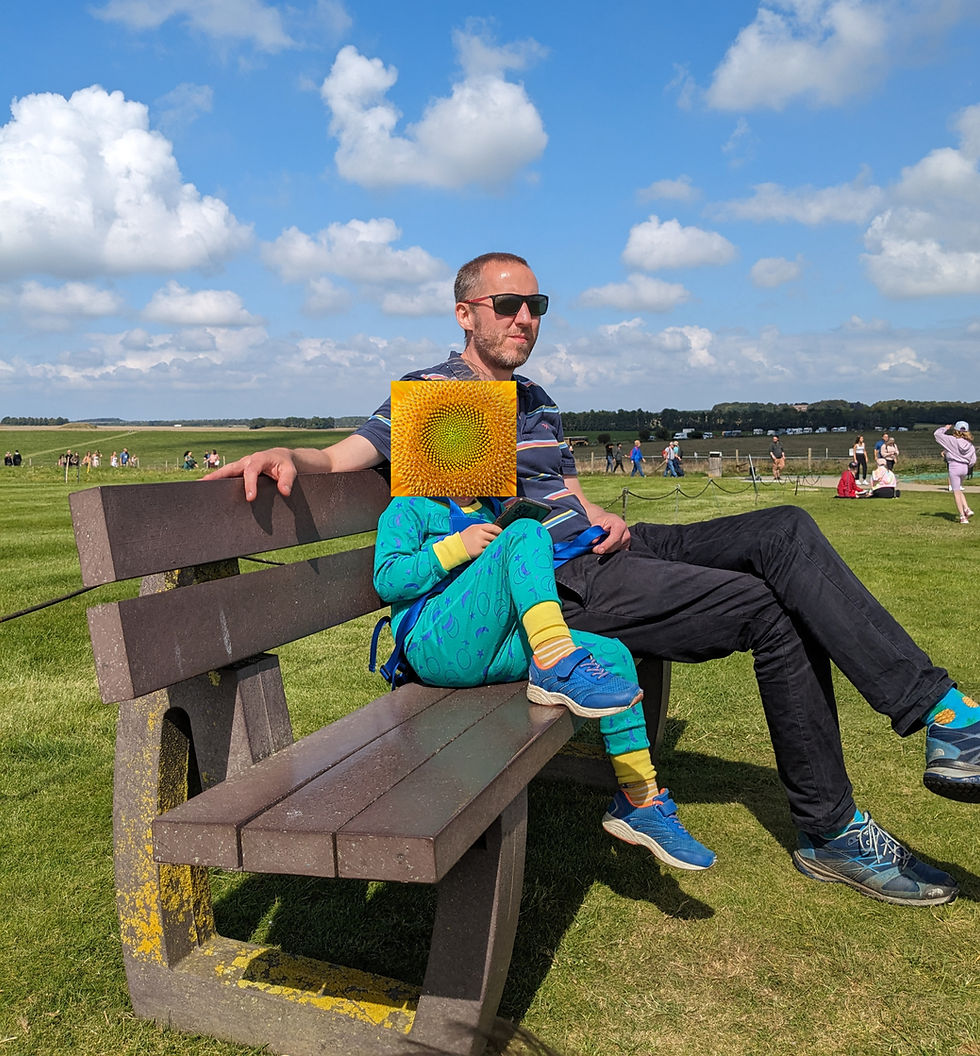
There was something very special about eating our picnic while gazing at the stone circle, and as we relaxed in the sun with the grass tickling our bare feet it was as if time stood still.
Despite the nearby busy A303, the area is surprisingly quiet and peaceful, making it perfect for a relaxed break.
How to Beat the Crowds for the Perfect Stonehenge Family Photo
As one of England's most famous landmarks, you can expect to encounter crowds whenever you visit.
Yet, somehow, the vastness of the site seems to just swallow everyone up.
If you are patient and prepared to wait a little, there will be small breaks in the flow of people. This is when the crowds thin out, making it much easier to get those perfect, clear family photos.
Walking the Ancient Circle
On arrival at the stones, visitors are gently encouraged to walk around in an anti-clockwise direction, though there is no rule stopping you from going the other way.
The whole site feels both bigger and smaller than I had expected! The circle's circumference is much larger than I had realised, and the stones are quite spread out. However, the monoliths themselves were not quite as tall as I had imagined.
Our autistic boys thoroughly enjoyed their time walking around Stonehenge, posing for photos, and watching the birds.
The crowds did not bother them as much as I had feared. This was likely because the open layout naturally encourages everyone to stay very spread out.
What I remember most is the incredible energy that seemed to emanate from the stones. Even the sheep grazing in the nearby fields seemed particularly zen!

Stepping Back in Time: Exploring the Neolithic Houses
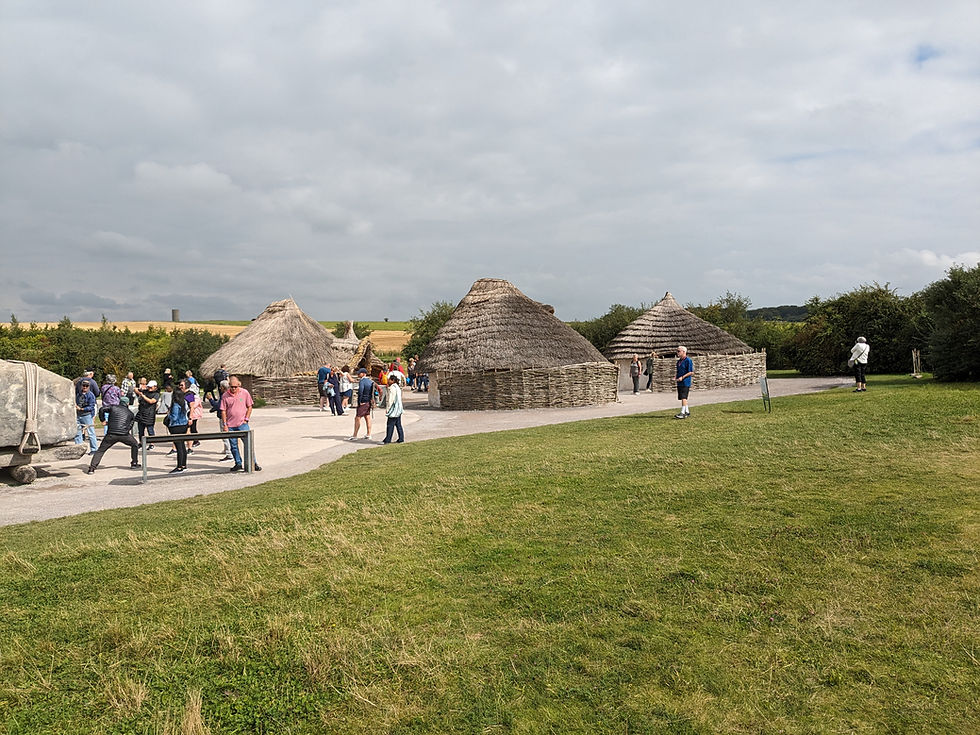
The Neolithic village is a fantastic addition to the Stonehenge site. It offers children an immersive way to step back in time and walk in the footsteps of their ancient ancestors.
Most of the replicated houses are completely open to the public. Visitors are encouraged to go inside, try out the beds, and sit around the central campfire pits.
It is a brilliant, interactive experience that is well worth dedicating some time to, especially if your kids have a keen interest in history, building, or architecture.
The Stonehenge Museum: Visual History & Heavy Lifting
The indoor museum exhibition is incredibly well done, and we managed to have a quick look around.
It is packed with brilliant visuals, interactive screens, and clear displays charting the deep history of the stone circle and the wider Neolithic landscape.
The Heavy Stone Cart Pull
This interactive stone-pulling exhibit is a total classic, but it was fantastic fun nevertheless!
The boys absolutely loved having a go at tugging on the heavy ropes. As a neurodivergent parent, I knew this heavy work was brilliant for giving them lots of grounding proprioceptive input.
The exhibit perfectly demonstrates the immense size of the monoliths and the clever methods ancient communities used to move them.
I had watched a fascinating BBC documentary on Stonehenge not long before we visited the site. A leading current theory is that these giant stones were transported all the way from Wales to Salisbury using river networks, wheels, and pulley systems.
Given their astronomical size and weight, it is an absolutely jaw-dropping human achievement!
Inspecting the Sarsen Stone
The Archaeology Tent: Seasonal Sensory Digging
Our boys had a fantastic time inside the archaeology experience tent. This interactive zone is generally set up during the Easter and August school holidays.
There was a short wait for the active session to finish—which our autistic kids just about managed! Then, the boys were invited to go inside and join a table.
Along with the other children, they listened to a very brief introduction to fossil hunting before choosing from a range of tools inside an archaeologist's toolkit.
They then had a brilliant time unearthing hidden fossils and artefacts inside the large sandboxes provided, happily sharing their finds with each other and us.
A Relaxed, Low-Key Environment
The entire session was actually very low-key and wonderful fun. There was plenty of physical space for all the children to spread out, meaning they never felt crowded or inside each other's spaces.
This is a seasonal activity for the summer holiday period. I have visited Stonehenge outside of the school holidays previously and this tent was not available.
If this hands-on digging is something your children would enjoy, it is definitely best to check the official English Heritage website for current events before you travel.

Stonehenge Autism Accessibility & Staff Review
As a world-famous attraction, Stonehenge is always bustling with activity. The site naturally focuses on managing large numbers of tourists efficiently.
Despite the high volume of visitors, we found the staff and volunteers to be incredibly friendly. If we had needed any additional support, I would have felt completely comfortable asking for help.
Is Stonehenge Accessible for Autistic Children and Carers?
English Heritage has put considerable effort into ensuring that Stonehenge is physically accessible across sight, hearing, and mobility needs.
While there is currently nothing that explicitly addresses the needs of neurodivergent adults and children (like a dedicated sensory room or a separate Sunflower lanyard queue), the sheer scale of the landscape makes a massive difference.
Because the site is so vast and open, our family was able to find plenty of quiet space and avoid sensory overload entirely. For more information on mobility access, you can check the official Stonehenge Access page.
What Are the On-Site Facilities Like?
The visitor centre features a clear, clean, and well-organized layout. The facilities include:
Accessible and disabled toilets
A large gift shop
An on-site café
The shuttle bus service to the stones
⚠️ Sensory Warning: The indoor café area gets incredibly busy, crowded, and loud. If your child is highly sensitive to noise or crowded spaces, it is definitely best to avoid the seating area if you can. We highly recommend packing a picnic to enjoy out on the peaceful grass instead!
Managing the Stonehenge Queues: Arrival and Shuttle Buses
The Entrance Queues
On arrival, the entrance is split into two distinct lines: one for pre-booked online tickets and one for buying on the day.
The pre-booked queue is significantly shorter, moves much faster, and saves you 15% on standard entry prices (you can book online up until 8:45 am on the morning of your visit).
We know that travelling with autistic children can be unpredictable. Committing to a non-refundable, fixed-time ticket can feel incredibly stressful if you aren't sure how the day will go.
Queue Hack for Families: If you do need to queue to buy tickets on the day, use this survival strategy: have one adult stand in the queue while the other adult waits somewhere quiet, or in the car, with your child. You do not have to enter the moment your tickets are bought, so your partner can simply come and collect you once they have the passes in hand.
The Shuttle Bus Queue
We chose to enjoy the woodland walking route up to the stones, which meant zero waiting around on our way there.
However, we did jump in a short queue to board the courtesy shuttle bus on our way back to the visitor centre. The line moved very quickly, felt completely manageable, and did not cause the boys any distress.
Does Stonehenge Offer Concessionary or Carers' Tickets?
Yes! If you are visiting as a special assistance family, there are fantastic money-saving options available:
Free Carer Tickets: English Heritage offers free essential companion/carer tickets for those supporting a visitor with disabilities. Disabled child tickets from £14.50, disabled / non disabled adults from £29 (at time of publication).
The National Trust Bonus: Entry to Stonehenge is completely free for both National Trust and English Heritage members.
💡 Our Money-Saving Travel Strategy:
Instead of paying for single-day entry, we highly recommend taking our approach and investing in an English Heritage Annual Family Membership*.
Up to six children can go free with every adult English Heritage member, making the pass an incredibly cost-effective option for families. If an additional adult (parent / grandparent / friend) can also go free as an essential carer, the savings start adding up.
Other great English Heritage attractions include: Dover Castle, 1066 Battle of Hastings, Whitby Abbey, Tintagel Castle and Kenilworth.
In our experience having a membership completely removes the pressure of travel planning. Our children can sometimes experience sensory overload around an hour after arriving at a landmark. When this happens we never worry about packing up and leaving immediately and there is no sense that we have wasted money on day tickets!
Final Thoughts: Is Stonehenge Worth the Trip?
The Stonehenge landmark is a truly fantastic destination for an autism-friendly family day trip.
Its massive, open-air layout offers endless space for autistic children to explore, run, or simply find a quiet pocket of land away from other people to self-regulate.
If your child has a hyper-focused special interest in history or building, this ancient monument is a brilliant way to kickstart deep conversations about Britain's Neolithic past. There is something genuinely magical about standing together inside such an ancient landscape.
Our family absolutely loved every second of our visit, and we would definitely head back for a repeat journey in the future!
Start Planning Your Journey
For more comprehensive information about site opening times, seasonal events, and facilities, head over to the official English Heritage Stonehenge Website*.
Don't forget to use the code EHSUM26 when signing up for your annual pass to secure your 25% summer discount before it expires on August 31st 2026!
Happy Travels x



Comments